By Inner Peace Control Team
Reading Time: 6 Minutes
You do not need a silent room, a cushion, or an hour of free time to feel calmer. You need five minutes and a willingness to pause.
Most people who avoid meditation do not avoid it because they think it is useless. They avoid it because it sounds like another thing they do not have time for. The word “meditation” still carries the weight of retreats, crossed legs, and forty-minute silent sits — none of which fit into a life already overflowing with notifications, deadlines, and noise.
The good news: that image is outdated. A five-minute practice, done consistently, changes how your brain responds to stress. And it does not require clearing your mind.
Quick Summary
- Five minutes of daily meditation measurably lowers stress and improves focus — consistency matters more than duration.
- You do not need to “clear your mind.” The practice is noticing when your mind wanders and gently returning.
- Three simple techniques — breathing, body scan, and loving-kindness — each take five minutes and work in any quiet moment.
- The biggest mistake beginners make is judging the practice. If you sat down and tried, the practice worked.
The Modern Problem
You wake up and check your phone. Before your feet touch the floor, your brain has already absorbed news, messages, and a dozen reasons to feel behind.
The day accelerates. Emails pile up. A notification pulls you sideways. By midafternoon, your shoulders are tight and your mind is racing through a mental to-do list that never shrinks. You know somewhere in the background that slowing down would help — but slowing down feels impossible when everything demands speed.
This is not a personal failure. It is what modern attention looks like. The average person checks their phone 144 times a day. Notifications are designed to hijack focus. Your brain, trying to keep up, stays in a low-grade state of alert that never fully switches off.
You do not need a personality change. You need a tool that fits into the cracks of a busy day — not one that demands you rebuild your entire schedule around it.

The Mindful Idea
Mindfulness, at its simplest, is the practice of paying attention to the present moment without judgment. That is the whole definition.
Notice the words “without judgment.” Most people who think they “can’t meditate” are actually meditating perfectly well — they are just judging themselves for it. Your mind will wander. That is what minds do. The practice is not stopping the wandering. The practice is noticing that you wandered and choosing to return your attention. Every time you do that, you complete one mental rep.
Research supports how little is needed. A 2018 study in Behavioural Brain Research found that five minutes of focused breathing produced measurable reductions in cortisol — the body’s main stress hormone — even in people who had never meditated before. Another study from the University of Waterloo showed that brief mindfulness sessions reduce “mind-wandering,” the mental chatter that fuels anxiety and overthinking.
Your brain does not need a long session to begin rewiring. It needs consistency. Five minutes daily for thirty days produces deeper, more lasting change than an occasional hour-long session.
Why This Still Matters Today
In 2026, attention is currency. Every app, platform, and notification competes for the same limited resource: the space between your ears. The ability to direct your own attention — to choose where your mind rests — has become a genuine competitive advantage.
But this matters for reasons deeper than productivity. When you cannot step back from your thoughts, you live at their mercy. A worry pops up, and you chase it. A frustration surfaces, and you react. An old memory arrives uninvited, and you spend twenty minutes relitigating a conversation that ended years ago.
Five minutes of practice interrupts that cycle. It builds something the Stoics called prosoche — attention to the present moment — and something modern psychology calls metacognitive awareness: the ability to observe a thought without becoming it.
Three Techniques You Can Use Today
Each of these takes roughly five minutes. Try one this morning.
Technique 1: Counted Breathing
This is the simplest entry point. It gives your analytical mind a small task so the rest of you can settle.
How to practice:
- Sit comfortably with your eyes closed. Take three deliberate breaths — inhale through the nose, exhale slowly through the mouth.
- Let your breath return to its natural rhythm. Notice where you feel it most clearly: nostrils, chest, or belly. Choose that spot as your anchor.
- Count each exhale silently: one, two, three… up to ten. When you reach ten, start over at one.
- If you lose count — and you will — simply begin again at one. No frustration. No scorekeeping. Returning is the practice.
- For the final thirty seconds, stop counting. Just breathe and notice the small pause between each inhale and exhale.
Best for: Racing thoughts, inability to focus, pre-meeting nerves.

Technique 2: Body Scan
The body scan is effective for people who carry stress physically — tight shoulders, clenched jaw, shallow breathing, tension headaches.
How to practice:
- Close your eyes. Take three deep breaths. Feel the weight of your body against your chair or floor.
- Bring your attention to the top of your head. Notice any tension, warmth, or sensation — without trying to change it.
- Slowly move down: forehead, eyes, jaw, neck. Breathe into any tightness you discover. Then release.
- Continue through shoulders, arms, hands, chest, stomach, lower back, hips, legs, and feet. Spend roughly twenty seconds on each area.
- For the final thirty seconds, expand your awareness to your whole body at once. Hold that wide attention for three slow breaths. Open your eyes.
Best for: Physical tension, feeling overwhelmed, trouble sleeping.
Technique 3: Loving-Kindness (A Quick Metta Practice)
This practice feels unusual to some people at first — silently wishing well to yourself and others. But research from Barbara Fredrickson’s lab at UNC found that regular loving-kindness practice increases positive emotions, improves social connection, and raises overall life satisfaction. It rewires the brain’s habitual hostility response.
How to practice:
- Close your eyes. Place one hand gently over your heart. Silently repeat: “May I be happy. May I be healthy. May I be safe. May I live with ease.” (One minute.)
- Picture someone you love unconditionally. Direct the same four wishes to them. (One minute.)
- Picture a neutral person — a barista, a neighbor, a coworker you barely know. Send the wishes to them. (One minute.)
- Picture someone you find difficult. Even a halfhearted attempt counts. Send the wishes. (One minute.)
- Expand outward: “May all beings be happy. May all beings be safe. May all beings live with ease.” Rest in the feeling for thirty seconds. Open your eyes.
Best for: Feeling disconnected, lonely, or irritated with someone.
Simple Exercise: The One-Breath Reset
Time: 60 seconds — or as long as one breath
You do not always have five minutes. Sometimes you have sixty seconds between meetings or while waiting for coffee to brew. This micro-practice fits any gap.
Steps:
- Stop what you are doing. Put down your phone.
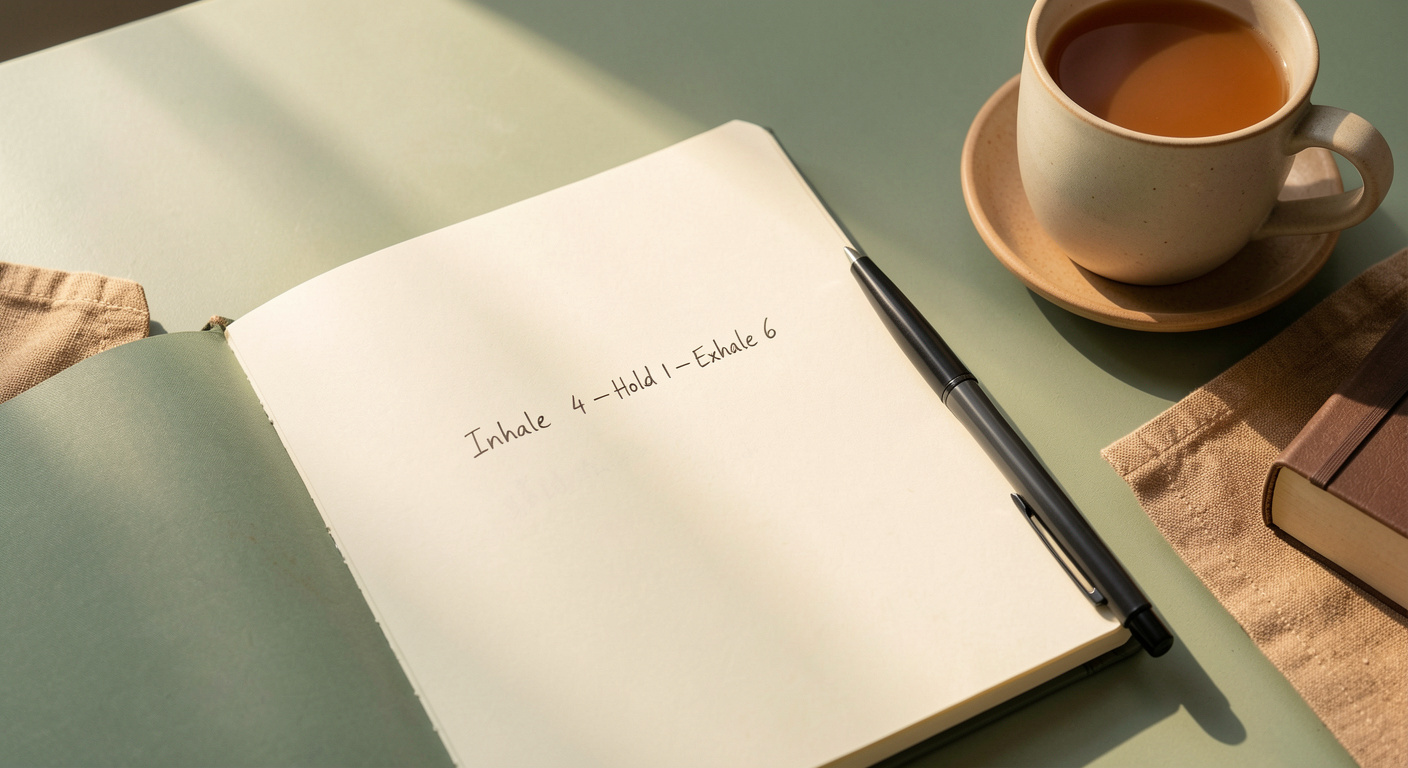
- Take one slow breath in through your nose, counting to four.
- Hold it for a count of one.
- Exhale through your mouth, slowly, counting to six. The extended exhale activates your parasympathetic nervous system — your body’s built-in calm switch.
- Notice what shifted, even slightly. Then continue your day.
Reflection question: What would change if you took one deliberate breath before sending your next emotional reply?
Common Mistakes
Mistake 1: Thinking you need an empty mind.
Meditation is not about stopping thoughts. It is about changing your relationship to them. Thoughts will arrive — that is the mind’s job. The practice is noticing and returning. If you did that even once, you meditated.
Mistake 2: Judging the session.
“There was too much noise.” “I could not focus.” “My mind was everywhere.” Every one of those thoughts means you were paying attention — which is the entire point. The content of the session is irrelevant. Showing up is the win.
Mistake 3: Waiting for the perfect moment.
The perfect moment does not arrive. Five minutes will never spontaneously appear on your calendar. Anchor your practice to an existing habit — right after your morning coffee, during your lunch break, or before you pick up your phone at night. Attach it to something you already do.
Mistake 4: Starting too ambitiously.
Do not aim for thirty minutes. Do not aim for every day this week. Aim for five minutes, three times this week. Then build. The habit is constructed by repetition, not intensity.
📚 New to mindfulness? Start with our Mindfulness for Beginners guide →
Final Reflection
You do not need to become a different person to feel calmer. You need to give your mind a small, regular break from the relentless forward motion of the day.
Five minutes is not a compromise version of meditation. It is the version that actually works for people with full lives. The science is clear: consistency rewires the brain, and five minutes daily outperforms occasional marathon sessions.
The calm you are looking for is not somewhere else. It is in the space between one thought and the next — a space you learn to notice by practicing, briefly and regularly, the simple act of paying attention.
Start today. Set a timer for five minutes. Try the counted breathing technique. When your mind wanders, return. When the timer sounds, continue your day.
That is the entire practice. That is enough.
This article is a simple reflection, not a replacement for professional mental health support. If emotions feel overwhelming or unsafe, professional support matters.