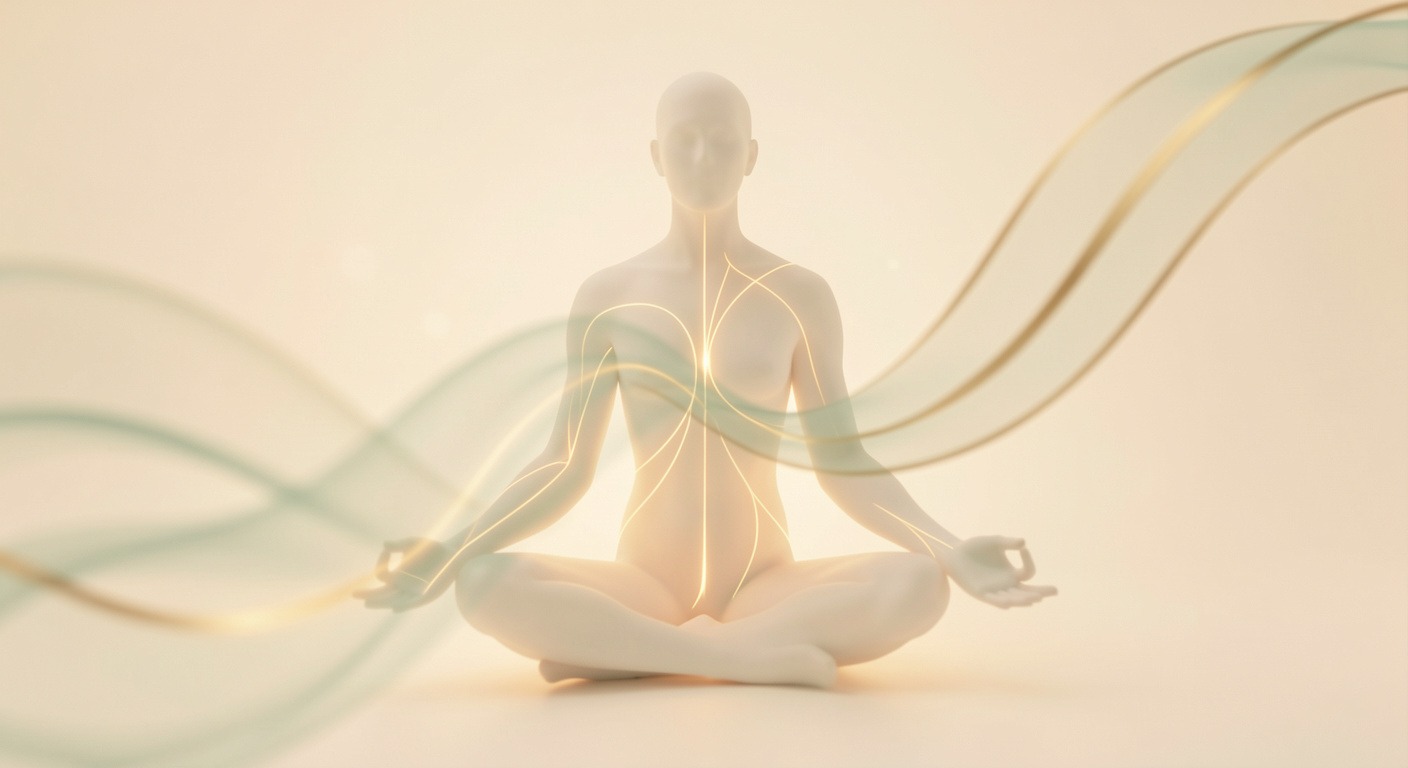
Wellness Notice: This guide is for educational and mindfulness purposes only. Body scan meditation may support relaxation and body awareness. It is not a substitute for professional medical advice, diagnosis, or treatment. If you have a history of trauma, severe anxiety, panic disorder, or chronic pain, please consult a qualified healthcare or mental health professional before beginning any new mindfulness practice.
Your body is speaking to you right now. You’ve just been too busy to listen.
Most of us live entirely in our heads: planning, worrying, replaying yesterday’s conversation while half-watching today’s. The body becomes an afterthought, something to fuel, dress, and drag from meeting to meeting. A body scan meditation changes that. It is one of the simplest mindfulness practices available, and it asks almost nothing of you except a few minutes and a willingness to pay attention.
This guide teaches you what body scan meditation is, how to practice it in five minutes, what to expect, and how to avoid the mistakes most beginners make. Whether you are curious about mindfulness, looking for a practical relaxation tool, or searching for a body scan meditation for beginners approach, this article covers everything you need to start today. You can think of it as a body awareness meditation, a meditation for body awareness that asks only for your attention, not your effort.
Quick Answer: What Is Body Scan Meditation?
Body scan meditation is a mindfulness practice where you slowly move attention through different parts of the body, noticing sensations like warmth, pressure, tension, tingling, or numbness without trying to change them. It trains interoceptive awareness , your ability to sense what is happening inside your body. Beginners can start with five minutes and build slowly. The goal is not to relax on command but to notice what is already present, without judgment.
Body Scan Meditation At a Glance
| Best for | Time needed | Position | Skill level |
|---|---|---|---|
| Beginners & experienced | 5–30 minutes | Lying down or sitting | Beginner-friendly |
| Main focus | What to notice | What not to do | Beginner goal |
| Body awareness | Warmth, pressure, tension, tingling, numbness, nothing | Don’t try to fix or change sensations | Notice one body part fully |
What Body Scan Meditation Means
A body scan meditation is exactly what it sounds like: you scan your body with your attention, moving slowly from one area to the next. You are not doing anything to the body. You are not stretching, massaging, or adjusting. You are simply noticing. Mindful.org describes it as a practice that helps you tune in to your body and reconnect with physical sensations you may have been tuning out.
Jon Kabat-Zinn, who developed Mindfulness-Based Stress Reduction (MBSR) at UMass Medical Center in 1979, made the body scan a core practice within the eight-week MBSR program. He describes mindfulness as “paying attention on purpose, in the present moment, and non-judgmentally.” The body scan is that principle applied directly to your physical experience.
Think of it this way: you are not a mechanic inspecting an engine for problems. You are more like a cartographer mapping terrain, curious about what is present, not desperate to change it. A knot in your shoulder is not a failure. It is data. A tingle in your foot is just a sensation.
For a deeper understanding of how mindfulness practices work, explore our guide on mindful breathing for beginners, which pairs naturally with the body scan.
Why We Feel Disconnected From the Body
We have gotten very good at overriding our bodies. Hungry? Push through until the meeting ends. Tired? Coffee. Tense shoulders from three hours hunched over a laptop? You will deal with it later , except later never arrives.
The body keeps score, and eventually the score settles in the form of chronic tension, poor sleep, and a low-grade hum of anxiety you cannot quite name. What makes this worse is that we treat the mind and body as separate things. The mind is the CEO; the body is the delivery truck. Keep the truck running and do not ask questions.
Research tells a different story. Interoceptive awareness, your ability to sense what is happening inside your body, is closely linked to emotional regulation. People who can accurately read their own internal signals tend to handle stress better and report greater well-being (Greater Good Science Center, UC Berkeley). When you lose touch with your body, you lose touch with an early warning system refined over millions of years.
How Body Scan Meditation Works
The mechanism is straightforward. You direct focused, non-judgmental attention to one body part at a time. The brain regions involved in interoception , particularly the insula and anterior cingulate cortex , become more active and more connected with regular practice.
According to the American Psychological Association, mindfulness meditation practices including the body scan are research-proven to reduce stress. A 2022 systematic review and meta-analysis published in Applied Psychology: Health and Well-Being found small but significant effects of body scan meditation on mindfulness outcomes (PubMed).
You are not forcing relaxation. You are training the skill of noticing. And the paradox of this practice is that when you stop trying to feel better, you often do feel better , not because you forced anything, but because you stopped fighting yourself.
This skill of noticing without reacting connects to a broader set of emotional regulation tools. If you find yourself reacting automatically in stressful situations, our guide on how to stop reacting automatically may be a helpful companion read.
Benefits of Body Scan Meditation
Regular practice of body scan meditation may support several areas of well-being. The National Center for Complementary and Integrative Health notes that mindfulness practices are generally considered safe for most people and are associated with modest improvements in stress, anxiety, and quality of life.
Here is what the research and practitioner reports suggest body scan meditation may help with:
- Stress reduction: Regular body scanning may lower perceived stress by interrupting the cycle of mental rumination and returning attention to the physical present. This is why many people turn to a body scan for stress relief as part of their daily wellness routine.
- Body awareness: Consistent practice can strengthen interoceptive awareness, helping you notice physical tension earlier before it accumulates.
- Sleep support: Many people find a body scan before sleep helps quiet mental chatter and ease the transition into rest. The practice shifts attention away from worried thoughts and toward physical sensations.
- Emotional regulation: By practicing non-judgmental noticing of body sensations, you may build the same skill for emotional experiences , observing feelings without being overwhelmed by them.
- Relaxation response: A relaxation body scan can help activate the parasympathetic nervous system, which supports rest and digestion, though individual results vary.
It is important to note that these are potential benefits supported by general mindfulness research. Body scan meditation is not a cure for anxiety, depression, chronic pain, or any medical condition.
Before You Start: What You Need
A body scan meditation for beginners requires very little. You do not need a cushion, a mantra, or a quiet monastery. Here is what helps:
- A quiet space: Find a place where you are unlikely to be interrupted for five to ten minutes. Silence is ideal but not required. Background noise is fine as long as it does not demand your attention.
- A comfortable surface: A bed, a yoga mat, or a carpeted floor all work. A firm but cushioned surface tends to be best.
- Loose clothing: Nothing that binds or distracts. Comfort is the priority.
- Dim lighting: Soft light signals the nervous system to settle. Bright overhead lights can feel activating.
- Optional: a guided audio. If silence feels intimidating, UCLA Mindful offers free guided body scan meditations, including a three-minute short version. Beginners often find a guided body scan meditation helpful for the first few sessions.
5-Minute Body Scan Meditation Step-by-Step
This is the actual practice. Set aside five minutes and follow the steps. No experience required. This 5 minute body scan meditation is designed to feel unhurried even in a short window.
Step 1: Get Comfortable
Lie down on your back with your arms at your sides, palms facing up. Let your feet fall open naturally. If lying down is not comfortable or convenient, sitting in a chair with both feet flat on the floor works too. Close your eyes or soften your gaze.
What to notice: The weight of your body against the surface beneath you. The points of contact: heels, back of the head, shoulders, hips.
Beginner reminder: There is no perfect position. Comfort is more important than form.
Step 2: Notice Your Breath
Breathe naturally for about a minute. Do not change your breathing. Just notice it. Feel the air moving in and out. Notice where you feel the breath most: your nose, your chest, your belly. Let your attention rest there.
What to notice: The rhythm of your breath. The slight pause between inhale and exhale. The temperature of the air.
Beginner reminder: You are not trying to breathe deeply or slowly. Natural breathing is the only target.
Step 3: Start at the Head
Bring your attention to the top of your head. What do you notice? Maybe a faint tingling on your scalp. Maybe the temperature of the air against your skin. Maybe nothing in particular , and that is fine. There is no right sensation. Just notice.
What to notice: Any sensation at all , or the absence of sensation. Both are valid data points.
Beginner reminder: Feeling nothing is not failure. It is information. Some body parts are subtler than others.
Step 4: Move Slowly Through the Body
Shift your attention downward: forehead, eyes, jaw (is your jaw clenched? Just notice , do not force it to unclench), neck, shoulders, arms all the way to your fingertips. Then chest, belly, lower back, hips, legs, knees, calves, ankles, feet, toes. Spend a few breaths on each area. Go slowly. There is nowhere to get to.
What to notice: Warmth, coolness, pressure, tingling, numbness, tension, heaviness, lightness, or restlessness. All of these qualify as sensations.
Beginner reminder: If you skip a body part accidentally, just continue. Perfection is not the goal.
Step 5: Notice Without Fixing
If your shoulder feels tight, the impulse is to relax it immediately. Resist that impulse. Just notice the tightness: its shape, its edges, whether it changes as you breathe. The noticing is the practice. If the sensation shifts naturally, that is fine. If it stays, that is also fine.
What to notice: Whether the sensation has a border or fades at the edges. Whether it pulses, throbs, or stays still. Whether it changes with your breath.
Beginner reminder: The practice is awareness, not fixing. You are building the skill of staying present with what is, not what you wish was there.
Step 6: Return When the Mind Wanders
Your mind will wander. Probably within the first thirty seconds. This is not a failure , it is how minds work. The practice is not about maintaining perfect focus. It is about recognizing when you have drifted and choosing to return without self-criticism. Every return is a repetition. You are building a muscle.
What to notice: Where your mind went (planning, remembering, judging the practice itself). Then gently return to the body.
Beginner reminder: The moment you notice you have wandered is the moment of mindfulness. That noticing is the win, not the blank mind.
Step 7: Finish With Whole-Body Awareness
Expand your awareness to your whole body at once. Feel yourself as a single, complete thing , breathing, alive, present. Sense the boundary of your skin. Feel the contact with the surface beneath you. Stay here for a few breaths. Then gently open your eyes.
What to notice: The feeling of being a whole organism rather than a collection of parts. The sense of aliveness that fills the body.
Beginner reminder: This final moment is about integration. You have scanned the parts. Now feel the whole.
Try This Now: 5-Minute Practice Box
Set a timer for five minutes. Lie down. Close your eyes. Take three natural breaths. Then bring your attention to the crown of your head and slowly move down through your body , head, face, neck, shoulders, arms, chest, belly, hips, legs, feet. Spend about 30 seconds on each major area. When your mind wanders, return gently. When the timer sounds, take one full breath while feeling your whole body, then open your eyes.
Reflection question: Which body part felt the most surprising to you , and what did you notice that you had not noticed before?
Body Scan Meditation Script for Beginners
If you prefer to follow a body scan meditation script or record your own guided version, here is a simple script you can use. Read it aloud slowly, pausing for a full breath between each instruction. The entire script takes about five minutes at a calm pace.
Find a comfortable position. Let your eyes close gently. Take a breath in, and as you breathe out, allow your body to settle into the surface beneath you.
Bring your attention to the top of your head. Notice any sensations there , warmth, coolness, tingling, or maybe nothing at all. Whatever you notice is welcome.
Now move your attention to your forehead and your eyes. Notice the small muscles around your eyes. Without trying to change anything, just notice.
Bring awareness to your jaw. Notice if there is any holding or clenching. There is no need to release it , just notice its presence.
Move to your neck and your shoulders. Feel the weight of your shoulders resting against the surface. Notice any tightness or ease.
Shift attention down both arms to your hands and fingertips. Feel the air on your skin. Notice any tingling or warmth.
Bring awareness to your chest and belly. Feel your breath moving here , the gentle rise and fall. Nothing needs to change.
Move through your hips and down both legs to your feet and toes. Notice the contact of your heels. Feel the weight of your legs.
Now expand your awareness to include your entire body. Feel yourself breathing, alive, whole. Stay here for a few breaths.
When you are ready, gently open your eyes.
What Sensations Might You Notice?
During body scan mindfulness practice, you may encounter a wide range of physical sensations. A mindfulness body scan trains you to notice all of these without judgment. Some will be obvious; others will be subtle. Some body parts will feel full of sensation; others will seem to offer nothing at all. All of this is normal.
Common sensations include:
- Warmth or coolness , temperature variations across different body regions
- Pressure , where the body contacts the floor, chair, or clothing
- Tingling or buzzing , a subtle vibratory quality, especially in hands and feet
- Numbness , a blank or absent feeling in certain areas
- Tension or tightness , often in the jaw, shoulders, neck, or lower back
- Heaviness or lightness , limbs may feel weighted or oddly buoyant
- Restlessness , an urge to move, itch, or adjust position
- Nothing noticeable , a neutral blank that offers no signal
Not feeling anything is also part of the practice. The goal is noticing, not forcing sensation. If a body part feels empty or absent, that is what you notice. You are not failing. You are accurately reporting what is present.
Common Mistakes Beginners Make
Most people learning how to do body scan meditation encounter the same obstacles. These are normal and fixable.
Trying to fix sensations instead of noticing them. If your shoulder feels tight, the automatic response is to relax it. Resist that. Just notice the tightness. The noticing is the practice. Relaxation may come as a side effect, but making it the goal gets in the way.
Common Mistake
Turning the body scan into a relaxation exercise where you actively release each muscle group. While this may feel good, it is progressive muscle relaxation , a different practice. The body scan is about awareness, not action. Notice the tension. Do not try to erase it.
Judging yourself when your mind wanders. Your mind will wander. Probably within thirty seconds. This is not failure , it is how minds work. Every time you notice the wandering and return, you are practicing the core skill. The return is the rep.
Going too fast. A five-minute body scan should feel unhurried. If you are racing from head to toe like you are checking off a grocery list, slow down. Spend a full breath on each body part. There is nowhere to get to. The scan is the destination.
Expecting a specific experience. Some sessions will feel peaceful. Others will feel restless, boring, or frustrating. None of these are wrong. The practice works through repetition, not through any single perfect session. Let each scan be what it is.
What If Body Scan Meditation Feels Uncomfortable?
For some people, bringing attention to the body can feel unsettling rather than calming. This is more common than most guides acknowledge, and it does not mean you are doing it wrong.
If body scan for anxiety brings up discomfort, try these adjustments:
- Practice with eyes open. Keeping a soft gaze on a fixed point can help you feel more anchored and less vulnerable.
- Start with the feet. Some people find beginning at the head too activating. Starting from the ground up can feel safer.
- Practice sitting rather than lying down. Lying down can evoke feelings of exposure. Sitting upright with back support may feel more contained.
- Keep sessions very short. Try two minutes instead of five. Build tolerance slowly.
- Use a guided recording. Another person’s voice can provide grounding when internal sensations feel overwhelming. UCLA Mindful offers free guided options.
If uncomfortable sensations persist or intensify across multiple sessions, consider pausing the practice. This does not mean you have failed. It means you are paying attention to what your body is telling you. That is the entire point.
When to Avoid or Modify Body Scan Meditation
Mindfulness practices are not universally comfortable for everyone. The NCCIH notes that while meditation is generally safe, some people may experience increased anxiety, disorientation, or other challenging effects.
Gentle Safety Note
Consider modifying or pausing body scan practice if you experience any of the following during or after a session:
- Anxiety increases significantly when focusing on the body
- Trauma memories or flashbacks arise
- Pain becomes overwhelming or sharply intensifies
- Panic symptoms appear (racing heart, shortness of breath, dizziness)
- Dissociation or emotional numbness feels frightening rather than neutral
- Chronic pain intensifies beyond manageable levels
If this happens: Open your eyes. Shift attention to the room around you. Feel your feet against the floor. Take a break. Use grounding techniques instead. For trauma, panic, severe anxiety, or chronic pain, practice with the support of a qualified therapist, trauma-informed mindfulness teacher, or healthcare professional.
For those working with trauma specifically, not all mindfulness practices are suitable without adaptation. Trauma-sensitive mindfulness approaches exist and may be more appropriate. A qualified mental health professional can help determine what is right for you.
How Often Should You Practice?
The Greater Good in Action guide from UC Berkeley recommends practicing the body scan three to six days per week. Their research-backed protocol suggests sessions as short as five minutes can produce benefits when done consistently.
What matters more than duration is regularity. Five minutes every day tends to produce more noticeable effects than thirty minutes once a week. The skill you are building , sustained, non-judgmental attention , grows through repetition, not intensity.
Start with three sessions per week. If that feels manageable, add a fourth. Let the practice fit your life rather than reshaping your life around the practice.
For more guidance on building consistent mindfulness habits, visit our daily mindfulness habits guide and the mindfulness practice guides hub.
Body Scan Meditation vs Breath Meditation
Body scan meditation and breath meditation are both mindfulness practices, but they emphasize different anchors of attention. Understanding the difference can help you choose the right practice for your current needs.
| Practice | Main Focus | Best For | Challenge | Beginner Tip |
|---|---|---|---|---|
| Body scan meditation | Physical sensations | Body awareness, stress relief, sleep | Mind wandering away from body | Use guided audio first |
| Breath meditation | Breath rhythm | Focus training, calming | Boredom with breath | Count breaths to anchor |
| Walking meditation | Movement sensations | Restlessness, active types | Coordination of walking plus noticing | Walk slower than feels natural |
| Loving-kindness meditation | Warm feelings toward self/others | Self-criticism, social connection | Feeling inauthentic or forced | Start with someone easy to love |
Many practitioners combine both approaches. You might start with a short body scan to settle into your body, then transition into breath meditation. There is no single correct sequence. Experiment and notice what works for you.
Frequently Asked Questions
What is body scan meditation?
Body scan meditation is a mindfulness practice where you systematically move your attention through different parts of the body, noticing physical sensations such as warmth, pressure, tension, or tingling without trying to change them. It is a core practice in Mindfulness-Based Stress Reduction (MBSR), developed by Jon Kabat-Zinn at UMass Medical Center in 1979. The goal is awareness, not relaxation , although relaxation often follows as a side effect.
How do beginners start body scan meditation?
Beginners should start with short sessions of five minutes in a quiet, comfortable space. Lie down or sit comfortably, close your eyes, and slowly move your attention from head to toe. Spend a few breaths on each body part. Notice whatever sensations arise without trying to change them. If your mind wanders, gently return to the body. Using a guided audio from a trusted source like UCLA Mindful can help during the first few sessions.
Should I do body scan meditation lying down or sitting?
Either position works. Lying down is the traditional posture and often allows deeper relaxation. Sitting upright with back support is a good alternative if lying down triggers drowsiness, discomfort, or feelings of vulnerability. Choose whichever position helps you stay alert yet comfortable. The practice does not depend on a specific posture.
How long should I practice body scan meditation?
Beginners can start with five minutes and build to fifteen or thirty minutes over time. The Greater Good Science Center at UC Berkeley recommends five-minute sessions practiced three to six days per week. Consistency matters more than duration. A five-minute daily practice tends to produce more noticeable effects than a thirty-minute session done once a week.
Can I do body scan meditation before sleep?
Yes, many people find a body scan before sleep helps quiet mental chatter and ease the transition into rest. By shifting attention from worried thoughts to physical sensations, the practice can support the natural wind-down process. If you tend to fall asleep during the scan, that is not a problem , practice earlier in the day if you want to maintain alert awareness, or practice in bed if sleep is your goal.
Why do I feel restless during body scan meditation?
Restlessness is extremely common, especially for beginners. The modern nervous system is accustomed to constant stimulation, and stillness can feel unfamiliar. Restlessness is not a sign that you are doing the practice wrong , it is a sensation like any other. Notice the restlessness: where do you feel it in your body? What is its quality? Treat it as part of the scan rather than an obstacle to it.
What if I feel nothing during body scan meditation?
Feeling nothing is a valid experience , not a failure. Some body parts naturally offer subtler signals than others. Noticing the absence of sensation is itself a form of awareness. Over time and with regular practice, your sensitivity to subtle body sensations may increase. But even if it does not, the practice of paying attention still holds value.
Is body scan meditation good for anxiety?
Body scan meditation may support some people in managing perceived anxiety by grounding attention in physical sensations rather than anxious thoughts. Research on MBSR, which includes the body scan, has shown modest reductions in anxiety symptoms for some participants. However, body scan meditation is not a treatment for clinical anxiety disorders. For some individuals, focusing on the body can temporarily increase anxiety. If this happens, consider shorter sessions, practicing with eyes open, or working with a qualified therapist.
Can body scan meditation make anxiety worse?
For some people, particularly those with panic disorder, trauma history, or high levels of health anxiety, bringing focused attention to bodily sensations can temporarily intensify anxious feelings. This is a known phenomenon in mindfulness research. If you experience this, try shorter sessions, practice sitting up with eyes open, start the scan from the feet rather than the head, or work with a trauma-informed mindfulness teacher or therapist who can adapt the practice to your needs.
Is body scan meditation safe for trauma?
Body scan meditation can be challenging for some people with a trauma history because it directs attention toward the body, which may be associated with traumatic memories or sensations. Trauma-sensitive mindfulness adaptations exist , such as keeping eyes open, practicing for very short periods, and emphasizing choice and agency throughout the practice. If you have a trauma history, it is advisable to explore body-based mindfulness practices with the support of a trauma-informed therapist rather than independently.
How often should I do body scan meditation?
Research suggests three to six sessions per week, with sessions as short as five minutes each. Start with what feels sustainable , even two or three sessions per week can build the habit. The goal is consistency over intensity. Choose a frequency you can maintain without it feeling like a burden.
What is the difference between body scan and breath meditation?
Both are mindfulness practices, but they use different anchors of attention. Body scan meditation uses physical sensations throughout the body as the object of focus. Breath meditation uses the breath as the primary anchor. Body scan is often more engaging for beginners because the anchor shifts every few breaths, which can make it easier to sustain attention. Breath meditation cultivates concentration on a single point. Both build the same underlying skill: noticing the present moment without judgment.
Final Reflection: Return to the Body Gently
The body scan will not transform your life overnight. It will not eliminate stress or dissolve difficult emotions. What it can do, reliably and over time, is change your relationship to your own experience.
When you spend five minutes actually inhabiting your body instead of treating it like a vehicle for your brain, something shifts. The relentless mental chatter gets a little quieter. Physical tension you did not know you were carrying loosens just enough to notice. And you walk back into your day feeling a bit more grounded , not because anything changed externally, but because you paid attention to what was already there.
The Stoic philosophers understood something that modern neuroscience is now confirming: you cannot control most of what happens to you, but you can practice how you relate to it. The body scan is one of the most direct ways to practice that skill. It asks nothing except your attention and rewards you with something quietly valuable , the sense that you are, at least for a few minutes, fully here.
Try it once. Then try it again the next day. The benefits accumulate quietly, the way most meaningful things do. And if you are looking for a structured starting point, our Start Here page can help you build a complete mindfulness foundation.
If the idea of accepting what is without resistance resonates with you, our guide on radical acceptance practice extends this principle beyond the body into daily life. And for a broader philosophical framework, explore our Stoic wisdom for emotional control collection.
Wellness Notice: Body scan meditation is an educational mindfulness practice, not a medical intervention. It may support relaxation and body awareness for some people but is not a treatment for anxiety disorders, depression, trauma, chronic pain, insomnia, or any medical or mental health condition. If you experience distressing physical or emotional reactions during mindfulness practice, pause and consult a qualified healthcare or mental health professional. Practicing with the guidance of a trauma-informed teacher is recommended for those with trauma history.
7 thoughts on “Body Scan Meditation: A Complete Beginner Guide”