Most people end the day exhausted, scrolling through their phone until sleep takes over. Seneca ended his day differently — and it changed everything.
We spend our days reacting. An email, a comment, a traffic delay, a disagreement — and before we know it, the day has passed without a single moment of genuine reflection. The Stoics saw this as a quiet tragedy. A life lived on autopilot is a life half-lived.
Seneca, the Roman statesman and philosopher, developed a simple evening practice that turns this around. It takes five minutes. It requires no app, no journaling expertise, and no special training. What it does require is honesty — and that, as it turns out, is the part most people avoid.

Quick Summary
- Seneca practiced a nightly self-review to examine his actions, words, and emotions
- The practice uses three simple questions that build self-awareness over time
- Modern research on self-reflection confirms what the Stoics understood 2,000 years ago
- You can start tonight with five minutes and a notebook
The Modern Problem
We end most days with a vague sense of dissatisfaction. Something went wrong — maybe a conversation we regret, a task we avoided, a reaction we wish we had controlled. But because we never stop to examine it, the same patterns repeat tomorrow.
The Stoics understood this. They knew that unexamined days lead to unexamined lives. Marcus Aurelius wrote his Meditations as a form of daily self-dialogue. Epictetus reminded his students to reflect on their impressions. But it was Seneca who gave us the clearest, most practical evening ritual — one that anyone can follow.
The Stoic Idea: Seneca’s Evening Court
In his essay On Anger (De Ira), Seneca describes a nightly practice he learned from the philosopher Sextius:
“When the light has been removed and my wife has fallen silent, aware of this habit that’s now become mine, I examine my entire day and go back over what I’ve done and said, hiding nothing from myself, passing nothing by.”
Seneca treated this review like a court appearance — but not a brutal one. He was the judge, and he was fair:
“Why should I fear any of my mistakes, when I can say: ‘See that you do not do this again. For now, I forgive you.'”
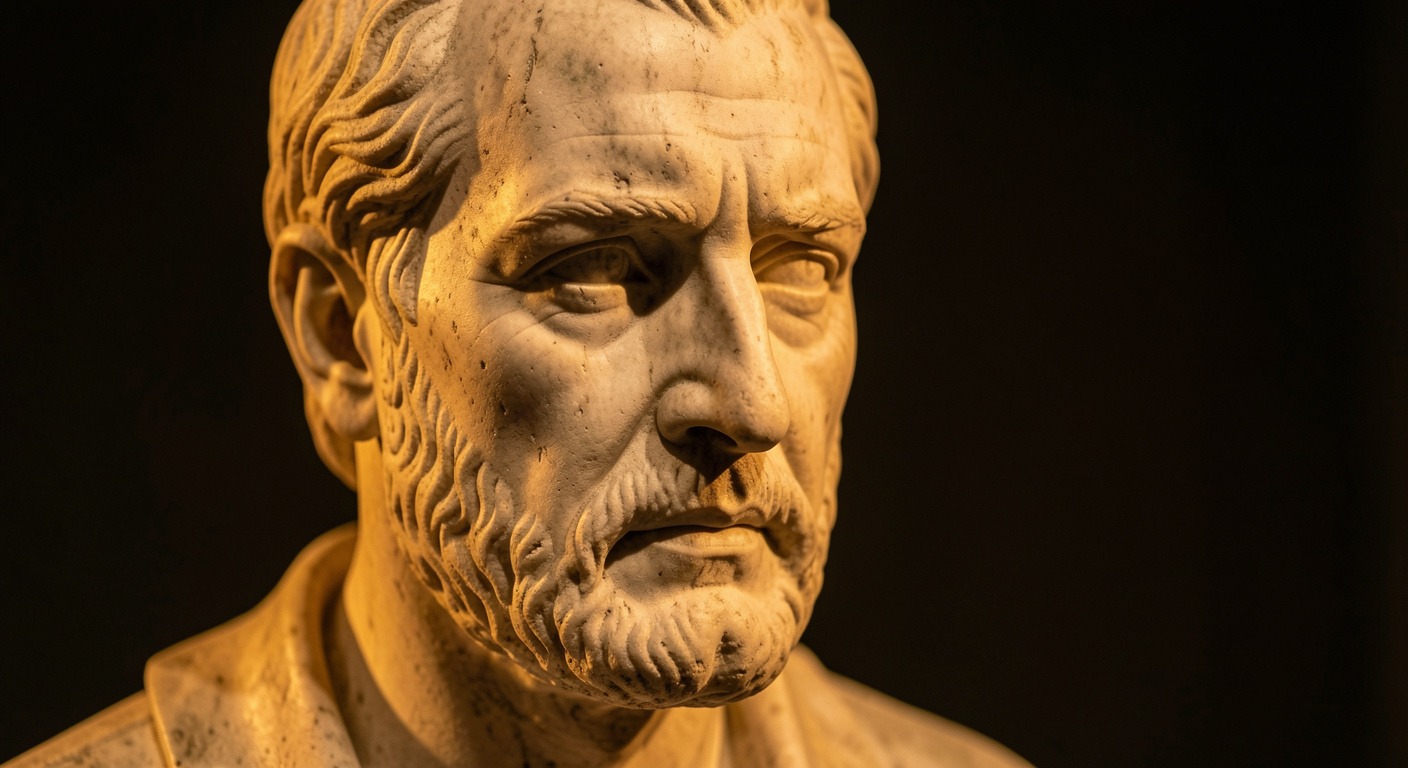
Three questions guided his review:
- What did I do wrong today? — Not to punish, but to see clearly. Did I lose patience? Did I speak harshly? Did I avoid something important?
- What did I do right today? — The Stoics did not dwell only on failure. Acknowledging what went well builds the confidence to keep improving.
- What could I do better tomorrow? — This is the forward-looking question. It transforms reflection from rumination into action.
The genius of this practice is not its complexity — it is its simplicity. Seneca did not write pages. He did not require a leather-bound journal. He simply paused at the end of the day and told himself the truth.
Why This Still Matters Today
We live in a culture that encourages distraction over reflection. Netflix, social media, podcasts — there is always something ready to fill the quiet space where honest self-examination might occur.
But the cost is high. Without reflection, the same anger keeps flaring. The same procrastination keeps winning. The same defensive reactions keep damaging relationships. You cannot change what you do not see.
Modern psychology confirms what Seneca knew. Research on self-reflection — particularly the work on self-monitoring and metacognitive awareness — shows that people who regularly examine their behavior make faster improvements and experience less emotional reactivity. The evening review is not mysticism. It is a feedback loop for the mind.
The difference is that Seneca’s version is kinder than most modern self-help. His goal was not perfection. It was awareness — and from awareness, gradual improvement.
What To Practice Instead
Instead of scrolling until sleep, try Seneca’s evening review tonight. Here is how to begin:
The Setup
Sit somewhere quiet. Put your phone in another room. You need nothing more than five minutes and something to write on — a notebook, a notes app, even the back of an envelope.
The Three Questions
Ask yourself, honestly:
- What did I do wrong today? — Be specific. Not “I was bad” — but “When my partner asked about the bill, I answered with frustration instead of patience.” The specificity is what makes the lesson stick.
- What did I do right today? — This matters as much as the first question. Did you hold your tongue when provoked? Did you complete a task you were avoiding? Did you show kindness to a stranger? Name it.
- What could I do better tomorrow? — Pick one thing — not ten. One small adjustment. “Tomorrow, when I feel the urge to interrupt, I will count to three first.” That is enough.
The Tone
Seneca’s tone was firm but forgiving. He did not berate himself. He treated his mistakes like a wise teacher treats a student — with clarity, not cruelty. Follow that model. If you find yourself in a spiral of self-criticism, you have moved from reflection to rumination. Pause. Breathe. Return to the questions with the same calm you would offer a friend.

Simple Exercise: The Five-Minute Evening Court
Time: 5 minutes
Steps
- Before bed, sit with your notebook and write today’s date.
- Write one sentence for each question: What did I do wrong? What did I do right? What will I adjust tomorrow?
- Read what you wrote aloud, once. Do not edit it. Do not judge it.
- Close the notebook. The review is over. Tomorrow is a new day.
Why It Helps
Writing forces specificity. The mind can drift through vague regret all night; a written sentence demands clarity. Reading it aloud adds a layer of accountability — you cannot hide from your own voice. And closing the notebook signals finality: the day has been examined, and now it can rest.
Common Mistakes
- Turning it into self-punishment. If your review leaves you feeling worse, you are doing it wrong. Seneca’s model includes forgiveness — explicitly. You must include it too.
- Trying to fix everything at once. The third question asks for one adjustment, not a complete personality overhaul. A single small change, repeated over weeks, creates more progress than ten ambitious resolutions abandoned by Wednesday.
- Skipping the positive. It is tempting to dwell only on mistakes. But Seneca’s review included what went right. Without that balance, the practice becomes demoralizing rather than strengthening.
- Overcomplicating it. You do not need a structured journal, a guided meditation, or an app subscription. Seneca did this in his head, in the dark, beside his sleeping wife. The simplicity is the point.
Final Reflection
You do not need to fix everything tonight. You do not need to become a different person by tomorrow morning. The evening review is not a transformation tool — it is a clarity tool. It helps you see yourself honestly, adjust one small thing, and approach tomorrow with slightly more intention than today.
Seneca did not become wise in a week. He practiced this for decades. What changed was not his nature — it was his awareness of his nature, and his quiet, persistent effort to improve it.
Tonight, when the lights are out and the noise has faded, ask yourself the three questions. Not to judge. Not to punish. Just to see.
That is the beginning.