
Reading Time: 6 Minutes
You’re lying in bed at 2 AM. The conversation from earlier today is playing on a loop in your mind. Should I have said that differently? What do they think of me now? What if I messed everything up?
Sound familiar?
Overthinking is the modern plague. It keeps us awake, drains our energy, and robs us of the very real, very good moments happening right in front of us. We replay, we predict, we catastrophize — and by the time we’re done, we’re exhausted from battles that never actually happened.
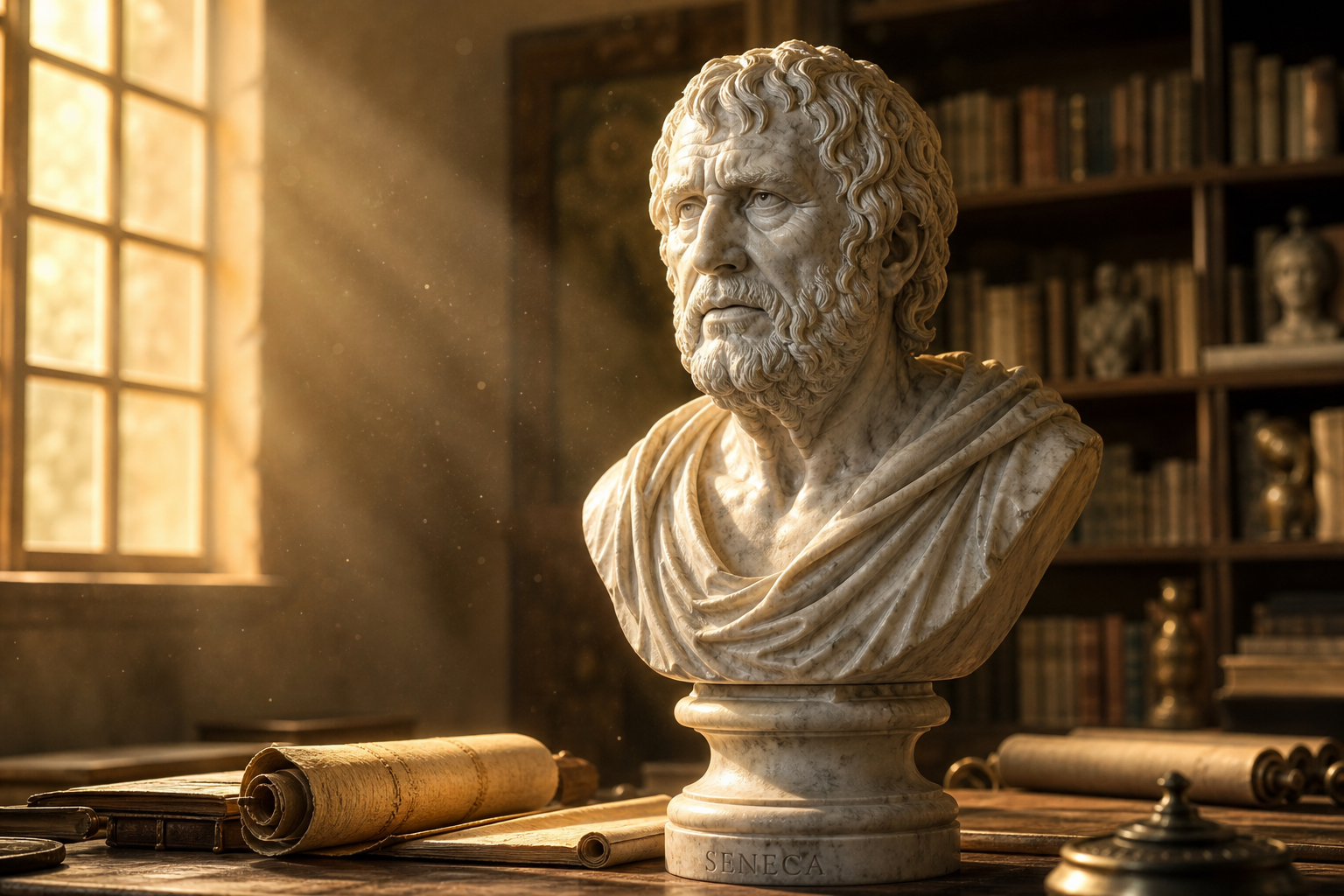
Nearly two thousand years ago, the Stoic philosopher Seneca put his finger on exactly this problem:
“We suffer more often in imagination than in reality.”
It’s one of the most quoted lines in all of Stoic philosophy — and for good reason. It names a truth most of us instinctively feel but rarely put into words: the worst part of our day is usually the part we made up in our heads.
Why Your Brain Conspires Against You
Here’s the strange thing about human psychology: your brain doesn’t know the difference between a real threat and an imagined one. When you lie awake worrying about a presentation next week, your body releases cortisol — the same stress hormone it would release if you were actually being chased by a predator.
Your brain is doing its job. It’s trying to protect you by scanning for danger. The problem is, in our modern world of endless information and social comparison, the “dangers” it finds are almost never life-threatening. They’re imagined scenarios, hypothetical failures, and stories we tell ourselves about what other people might be thinking.
Seneca understood this perfectly. He wrote:
“There are more things likely to frighten us than there are to crush us; we suffer more often in imagination than in reality.”
The fear feels real. The anxiety is real. But the thing you’re afraid of? It probably isn’t.
Why This Matters More Than Ever
If Seneca could see us now — phones buzzing with notifications, doom-scrolling before bed, comparing our behind-the-scenes to everyone else’s highlight reel — he wouldn’t be surprised. He’d nod knowingly and say, “I told you so.”
The digital age has supercharged our imagination. We don’t just worry about what happened today; we worry about what’s happening everywhere, all at once. A friend doesn’t text back for three hours, and suddenly we’ve constructed an entire narrative about why they’re angry at us. A colleague gets promoted, and we spiral into a story about our own inadequacy.
The cure isn’t more information, more reassurance, or more control. The cure is learning to recognize the difference between real problems and imagined ones — and then investing your energy only in the ones that actually exist.

3 Stoic Practices to Break Free from Overthinking
Here are three practical tools — grounded in Stoic philosophy — that you can use today to stop suffering in imagination and start living in reality.
1. The Labeling Technique: “Is This Real or Imagined?”
When you catch yourself spiraling, pause and ask one question:
“Is this a real problem I can act on, or an imagined one I can let go of?”
A real problem has a concrete solution. Your car broke down — you need to call a mechanic. You have a deadline — you need to start working. These are real. You can do something about them.
An imagined problem is speculative, based on a future that hasn’t happened or a past you can’t change. What if they don’t like my idea? What if I fail? These are stories, not facts.
Marcus Aurelius put it simply: “If you are distressed by anything external, the pain is not due to the thing itself, but to your estimate of it; and this you have the power to revoke at any moment.”
Try this: The next time you feel anxious, write down exactly what you’re worried about. Then draw a line down the page. On the left, write the facts (what has actually happened). On the right, write the story (what your imagination has added). Nine times out of ten, the right column will be much longer.
2. The 10-Year Rule
Seneca also advised us to put our troubles in perspective. He knew that most of what feels enormous today will be forgotten in a week, let alone a decade.
The next time you’re spiraling about something — an awkward social moment, a mistake at work, a disagreement with a loved one — ask yourself:
“Will this matter in 10 years? Will I even remember it in 10 days?”
This isn’t about dismissing your feelings. Your feelings are valid. It’s about putting them in their proper place. The Stoics called this the “view from above” — zooming out until your problems shrink to their true size.
Most of what keeps you up at night will be a footnote in your life’s story, not a chapter.
3. Focus Only on What’s Yours
Epictetus opened his Enchiridion with a powerful distinction: some things are up to us, and some are not. Our opinions, choices, and actions are ours. Everything else — other people’s opinions, the weather, the stock market, what your boss thinks of you — is not.
When you find yourself overthinking, ask: Is this within my control?
If yes, take action. If no, let it go. Not “try to let it go” — actually let it go. It doesn’t belong to you. Carrying it is optional, and you’re choosing to suffer.
This single practice, applied consistently, can cut your mental stress in half within a week.

📚 Read our complete Stoicism for Beginners guide →
Try This Today
Right now, take a deep breath. Look around you. Notice three things you can see, two things you can hear, and one thing you can feel. This is reality — the only moment that actually exists.
Now ask yourself: What am I suffering from that hasn’t actually happened?
Most of us will find the answer comes quickly. And once you name it, you can release it.
Seneca’s wisdom isn’t about pretending life is easy. It’s about recognizing that life is hard enough without adding imaginary suffering on top of it. The world will throw real challenges your way — lost jobs, health scares, heartbreak. Save your strength for those. Don’t waste it on the stories your mind makes up at 2 AM.
As Seneca himself concluded: “We are more often frightened than hurt; and we suffer more from imagination than from reality.”
The antidote to overthinking isn’t more thinking. It’s presence. It’s action. It’s the courage to see what’s real and let go of what’s not.
That’s not just philosophy. That’s freedom.
Why This Matters: The mind is a magnificent tool, but left unchecked, it becomes a prison of its own making. By learning to distinguish real problems from imagined ones, you reclaim your energy, your sleep, and your peace. This is the heart of Stoic practice — not to avoid pain, but to stop creating it where none exists.
1 thought on “We Suffer More in Imagination Than in Reality: Seneca’s Timeless Antidote to Overthinking”