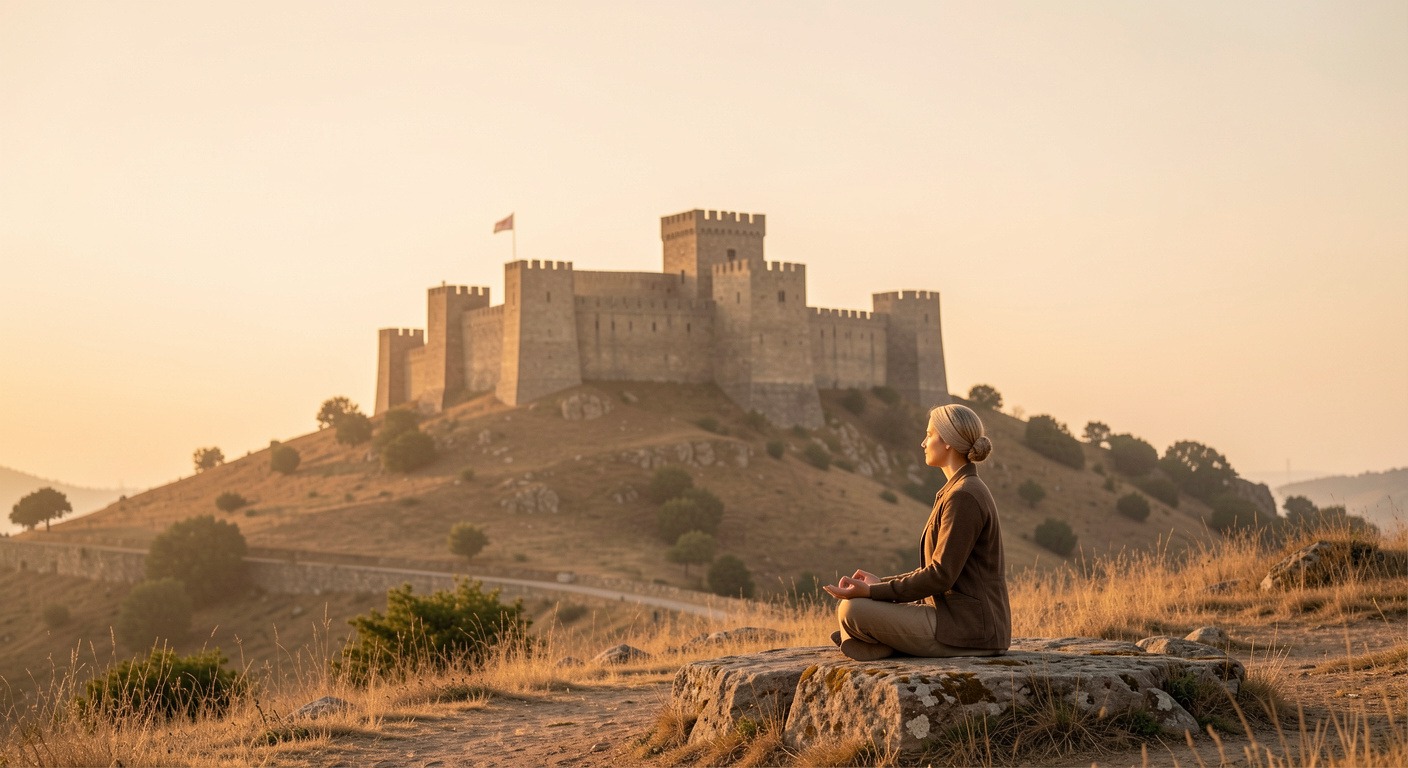
Inner Freedom: The One Thing No One Can Take from You
Wellness Disclaimer: This article explores Stoic philosophy for self-reflection. It is for educational purposes only and is not a substitute for professional mental health care.
You feel trapped. Stuck in traffic with your chest tightening. Overwhelmed by a news cycle you cannot escape. Drowning in a situation that feels inescapable.
The Stoics would tell you something surprising: you are not trapped. Inner freedom stoic philosophy describes is not a feeling to chase or a technique to master. It is a territory you already possess, and no external power can confiscate it. Just notice it.
The Problem: Looking for Freedom in the Wrong Places
Most people search for freedom where it cannot be found. A new job. A different relationship. Enough money to finally stop worrying. The promise is always the same: “I will be free when…”
But external freedom is never secure. If your sense of freedom depends on circumstances, it depends on things you cannot control. The real problem is looking for freedom in the wrong direction.
The Inner Freedom Stoic Philosophers Mapped
Epictetus, a former slave turned philosopher, drew the map two thousand years ago:
“Of things some are in our power, and others are not. In our power are opinion, movement towards a thing, desire, aversion; and in a word, whatever are our own acts: not in our power are the body, property, reputation, offices, and in a word, whatever are not our own acts. And the things in our power are by nature free, not subject to restraint nor hindrance: but the things not in our power are weak, slavish, subject to restraint, in the power of others.”
>
— Epictetus, Enchiridion, Chapter I (tr. Elizabeth Carter)
“By nature free” is the key phrase. Epictetus describes how reality is built, not a technique to try. Your opinions, your choices, your values are constitutionally beyond anyone’s reach. This is epictetus freedom: not the absence of chains, but the presence of an inviolable inner territory.
He then dismantles every false candidate:
“What then is that which makes a man free from hindrance and makes him his own master? For wealth does not do it, nor consulship, nor provincial government, nor royal power; but something else must be discovered. … Is any man able to make you assent to that which is false? No man. In the matter of assent then you are free from hindrance and obstruction.”
>
— Epictetus, Discourses, Book IV, Chapter 1 (tr. George Long)
Wealth cannot give you this. Power cannot. Stoic freedom lives in the one space no external force can enter: your capacity to judge, to choose, to respond.
Key Concept: The Inner Citadel
Marcus Aurelius, writing from a military tent on the Roman frontier, gave this truth its most vivid image:
“Men seek retreats for themselves, houses in the country, seashores, and mountains; and thou too art wont to desire such things very much. But this is altogether a mark of the most common sort of men, for it is in thy power whenever thou shalt choose to retire into thyself. For nowhere either with more quiet or more freedom from trouble does a man retire than into his own soul, particularly when he has within him such thoughts that by looking into them he is immediately in perfect tranquility; and I affirm that tranquility is nothing else than the good ordering of the mind.”
>
— Marcus Aurelius, Meditations, Book IV, Section 3 (tr. George Long)
This is the marcus aurelius inner citadel: a portable sanctuary requiring no plane ticket. He returns with greater force:
“Therefore the mind which is free from passions is a citadel, for man has nothing more secure to which he can fly for refuge and for the future be inexpugnable. He then who has not seen this is an ignorant man; but he who has seen it and does not fly to this refuge is unhappy.”
>
— Marcus Aurelius, Meditations, Book VIII, Section 48 (tr. George Long)
“Inexpugnable” means a fortress that cannot be taken by assault. The stoic inner citadel is Marcus’s military-grade assessment of the mind, and his warning is clear: knowing this refuge exists but never retreating to it is unnecessary suffering.
Why This Works: Frankl and the Modern Proof
Two thousand years later, psychiatrist Viktor Frankl arrived at the same conclusion through surviving Auschwitz rather than studying philosophy:
“Everything can be taken from a man but one thing: the last of the human freedoms — to choose one’s attitude in any given set of circumstances, to choose one’s own way.”
>
— Viktor E. Frankl, Man’s Search for Meaning
Frankl observed that prisoners maintaining this mental freedom were more likely to survive. Those who surrendered it died faster. This is what no one can take from you, tested in humanity’s darkest chapter.
Julian Rotter’s locus of control research showed internal control predicts resilience and better mental health. Deci and Ryan’s self-determination theory identifies autonomy as a fundamental need. Finding peace in chaos is a documented capacity rooted in recognizing your mental freedom.
Practical Exercise: The Inner Citadel Check (2 Minutes)
This exercise reveals what is already there.
Step 1: The Pause (30 seconds). When you notice the thought “I feel trapped” or “I will be free when [X changes],” stop. Plant your feet. Take one deep breath. Choosing to pause is itself an act of freedom.
Step 2: The Two-Column Scan (60 seconds). Mentally draw two columns. Left: “Things I cannot control right now.” List them quickly: other people’s actions, the past, the economy, the traffic. Right: “Things I can control right now.” List them: my next breath, my opinion, where I direct my attention, what I value right now.
Step 3: The Territory Check (30 seconds). Look at the right column. Ask: Is anyone forcing me to think what I am thinking? Is anyone compelling me to value what I am valuing? Can anyone take away my ability to choose my next response? The answer to all three is no. This right column is your inner freedom. Say to yourself: “This is mine. No one can take it. I am already free here.”
Common Mistakes
The most common mistake is believing freedom requires changing your circumstances first. “I will feel free once I leave this job.” “I will feel free once this conflict is resolved.” This is the trap: it keeps you running toward a horizon that never arrives.
Another mistake is confusing inner freedom with passivity. Recognizing your citadel does not mean you stop trying to improve external conditions. It means your inner peace stops being hostage to whether those conditions improve. You act, but you do not give external outcomes the power to define your soul.
Deeper Dive: Seneca on the Ultimate Key
Seneca takes the logic further. He argues the fear of death is the master chain enslaving us to circumstances:
“Think on death. In saying this, he bids us think on freedom. He who has learned to die has unlearned slavery; he is above any external power, or, at any rate, he is beyond it. What terrors have prisons and bonds and bars for him? His way out is clear. There is only one chain which binds us to life, and that is the love of life.”
>
— Seneca, Letter XXVI (tr. Richard Mott Gummere)
This is emancipation, not morbidity. When you stop clutching at life, nothing external can threaten you. That is the deepest form of inner peace.
How to Start Today
Start with a single sentence, repeated silently when you feel the walls closing in: “The things in my power are by nature free.” Say it. Believe it. Then locate one thing in your right column: one opinion, one choice. Exercise your freedom there. Every other Stoic practice leads back to this same ground.
Reflection Question
If you truly believed that no one can take from you your opinions, your choices, your values, and your response to this moment, what would you stop being afraid of? And what would you start doing with that fear no longer driving you?
Final Reflection
You have been free this whole time. The Stoics mapped territory that was always yours. Frankl walked through hell and confirmed it. The citadel is not something you build. It is something you return to, whenever you choose. The door is always open.
Social Media Highlight
“You are free right now. Not when circumstances change. Not when the fear subsides. Now. The things in your power are by nature free, and no one can take them from you.”
Wellness Disclaimer: This article explores Stoic philosophy as a framework for self-reflection. It is not a substitute for professional mental health care. If you are experiencing significant distress, please consult a qualified mental health professional.
